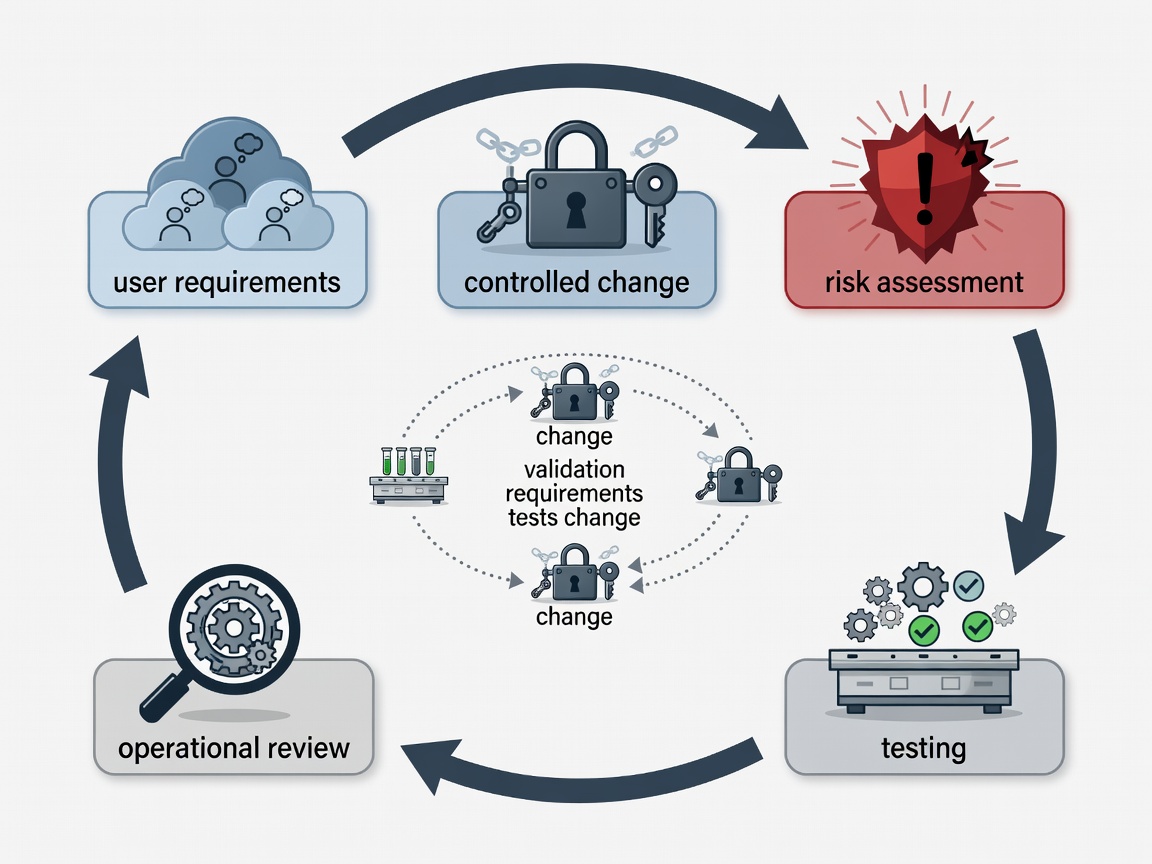
Prove the intended use, not a slogan
A supplier may describe a platform as suitable for regulated manufacturing. That description does not establish that a particular installation is fit for its configured use. The regulated organization needs a justified approach to requirements, risk, evidence and responsibilities. Validation is strongest when it makes the reasoning visible: which failures matter, which controls address them and how the evidence demonstrates performance.
01 / Intended use
Define the decision the system supports
Requirements should explain the functions and records needed for the actual process. “The system shall be compliant” is not a useful testable requirement. A clearer requirement might define who may approve a recipe, how unauthorized changes are prevented and which history must be retained. The level of detail should support design, verification and operation.
Business needs and quality risks should be distinguished without separating them completely. An inconvenient display can become a quality issue if it encourages a predictable workaround. Operators, engineering, information technology and quality personnel therefore need a shared understanding of the intended workflow and its boundaries.
02 / Risk assessment
Concentrate effort where failure matters
Risk-based work considers the consequences of failure, the likelihood and uncertainty involved, and the ability to prevent or detect a problem. A calculation alone does not replace expert reasoning. Teams should document assumptions and avoid treating a numerical score as proof that a concern can be ignored.
ISPE GAMP 5 offers guidance for a risk-based approach to compliant computerized systems. ASTM E2500 addresses specification, design and verification of pharmaceutical and biopharmaceutical manufacturing systems and equipment. These resources can inform an approach, but neither is a certificate for an installation. Their concepts must be interpreted within applicable requirements and the organization’s quality system.
03 / Verification
Challenge ordinary and abnormal behavior
Testing should show that important requirements are met under relevant conditions. Normal execution is only part of the picture. Invalid input, interrupted communication, power recovery, access restrictions and boundary conditions may be especially important where they affect product quality or data integrity. Expected outcomes should be clear enough to distinguish a genuine pass from a convenient interpretation.
Supplier evidence can be useful when its relevance and reliability are assessed. Repeating every supplier test may add little value; accepting every supplier claim may leave important gaps. The organization should understand which configuration and environment were tested and what site-specific evidence remains necessary.
04 / Controlled change
Assess the impact before implementation
A change can affect more than its visible function. Updating an operating system may alter communication behavior; replacing a sensor may change resolution or response time; revising a recipe may affect a model’s operating domain. Change assessment should consider interfaces, records, training, procedures and the continued validity of existing evidence.
Testing and approval should be proportionate to that assessment. Rollback arrangements and recovery checks may be needed. Emergency changes still require an authorized route, appropriate documentation and follow-up. ICH Q12 addresses technical and regulatory considerations for pharmaceutical product lifecycle management; computerized-system changes also need their own relevant operational controls.
05 / Continued operation
Keep the validated state observable
Operational oversight includes incident handling, access review, backup and restoration checks, maintenance and periodic assessment. Recurring alarms, unexplained data gaps and repeated manual corrections may indicate that the system is no longer performing as intended. A periodic review should evaluate actual experience, not merely confirm that the original documents still exist.
Cybersecurity supports this effort because compromised availability or integrity can affect manufacturing evidence. IEC 62443 provides industrial automation and control-system security concepts. NIST guidance can also inform security practice. Security patches should be managed through appropriate assessment rather than being ignored indefinitely or installed without considering production impact.
06 / Responsibilities
Retain ownership through retirement
System owners, process owners, quality personnel and technical specialists need defined responsibilities. A cloud service or support contract can distribute tasks, but it does not automatically transfer the regulated organization’s accountability. Agreements should address access, incidents, changes, data availability and exit arrangements in terms that can be put into practice.
Retirement is itself a controlled activity. Required records must remain accessible with sufficient context, and dependent interfaces must be addressed. EU GMP Annex 15 provides qualification and validation context, while Annex 11 addresses computerized systems. Their current scope and relationship to local requirements should be checked before planning a specific validation strategy.

Terminology: qualification versus validation
Qualification commonly demonstrates that equipment, facilities or utilities are suitable and perform as intended. Validation addresses documented evidence for a process or system’s intended performance. The terms interact and should be used consistently within the applicable framework.
Terminology: testing versus validation
Testing generates part of the evidence. Validation is the broader lifecycle activity that connects intended use, risk, requirements, evidence, approval and continued control.